
What Is the Backrooms Movie About?
A complete guide to Backrooms (2026): the spoiler-free premise, full plot, ending explained, themes, cast, internet origins, and an honest professional review.
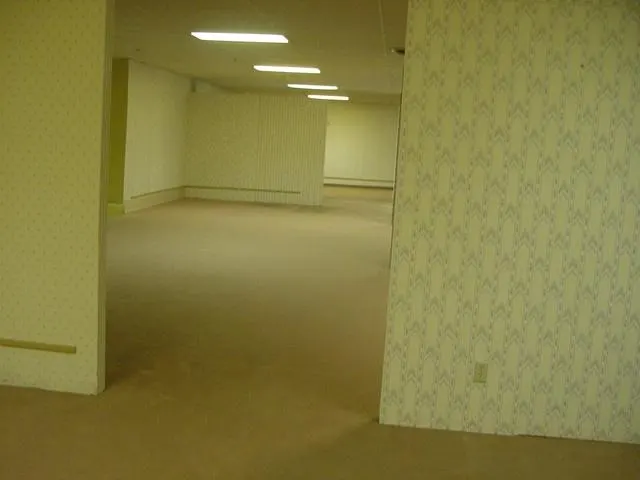
The Backrooms turn ordinary commercial space into something infinite, familiar, and wrong.
The short answer (no spoilers)
Backrooms is a 2026 psychological science-fiction horror film about Clark, a failing furniture-store owner who discovers a doorway in his basement leading to an apparently endless maze of yellow rooms, misplaced objects, and imperfect copies of reality. He first fears the place, then becomes obsessed with understanding it. When Clark disappears, his therapist Dr. Mary Kline enters the maze to find him and discovers that the Backrooms do more than trap people: they learn from human memories and reproduce them incorrectly.
The film is less a conventional monster movie than a story about memory, denial, trauma, and behavioral loops. Its central horror is not simply that a creature may be around the next corner. It is that the maze can absorb a person’s inner life and turn it into architecture.
Backrooms (2026) at a glance
- Director: Kane Parsons, also known online as Kane Pixels
- Screenwriter: Will Soodik
- Main cast: Chiwetel Ejiofor as Clark and Renate Reinsve as Dr. Mary Kline
- Also featuring: Mark Duplass, Finn Bennett, Lukita Maxwell, and Avan Jogia
- Genre: Psychological horror, science fiction, liminal horror
- Setting: 1990, principally inside a struggling furniture showroom and the dimension beneath it
- U.S. theatrical release: May 29, 2026
- Do you need to watch the YouTube series first? No. The film works as an entry point, although the series adds context to Async and the wider mythology.
The official A24 synopsis is deliberately minimal: a strange doorway appears in the basement of a furniture showroom. The feature expands that hook into a human story while preserving the found-footage textures and impossible spaces that made Parsons’ online work distinctive.
Where did the Backrooms idea come from?
The Backrooms began as internet folklore. In 2019, an image of an empty, yellowed interior was paired with a short piece of text imagining what would happen if someone “no-clipped” out of reality, like a video-game character passing through a solid wall. The result would be an enormous non-place of damp carpet, fluorescent hum, and rooms that seem designed for people even though nobody is there.
Because the original premise was open-ended, online communities added levels, creatures, rules, and competing canons. Kane Parsons did not invent the first Backrooms post, but his 2022 YouTube short, The Backrooms (Found Footage), gave the idea a particularly influential visual language. His series introduced analogue corporate recordings, scientific exploration, and the mysterious Async Research Institute. The feature film is based most directly on this interpretation rather than trying to catalogue every piece of fan lore.
What is the Backrooms movie really about?
On the surface, it is about finding a portal and getting lost. Underneath, it is about two people who have built very different defenses against pain.
Clark is a frustrated former architect whose furniture business, marriage, and self-image are collapsing. He drinks, lashes out, and treats his failures as things done to him. The Backrooms initially terrify him, but they soon offer something the outside world will not: a space that appears to reorganize itself around his memories. Inside it, he can imagine that he is still important and that his past can be rebuilt.
Mary, by contrast, has made a profession out of escape. Her work teaches people to recognize the “loops” that keep them trapped. That theory comes from her childhood with a controlling, agoraphobic mother and from the demolition of the house that contained them. Mary believes that naming a pattern gives her power over it. The film tests that belief by placing her in a loop that can physically copy her memories.
The Backrooms therefore function as both a science-fiction mystery and a psychological mirror. They remember the world the way a dream does: approximately. A room, a person, or an object may be recognizable, but scale, anatomy, purpose, and chronology are wrong.
Full plot summary
Major spoilers begin here.
The film opens with recovered footage connected to Async, a research organization already exploring an impossible interior realm. A cameraman separated from his team moves through vacant rooms before encountering something inhuman. The film then shifts to Clark’s more ordinary but already unstable life in 1990.
Clark owns the nearly empty Cap’n Clark’s Ottoman Empire, a furniture showroom promoted through embarrassing pirate-themed commercials. He is going through a divorce, sleeping at the store, struggling financially, and attending therapy with Mary. Flickering lights and a huge electricity bill lead him to investigate unusual switches and a lower level. During a blackout, he finds light where no room should exist and passes through a wall.
On the other side is the Backrooms: monotonous yellow corridors, furniture embedded where it cannot belong, dead birds, undersized doors, and architecture without a coherent plan. Clark is chased by a skeletal humanoid but escapes. He brings back a stool as evidence, yet Mary and his employees still struggle to accept his account.
Clark returns with assistant manager Kat and her filmmaker boyfriend Bobby, hoping to document and map the space. Their expedition turns catastrophic. Bobby encounters the creature while being lowered into another area; Kat is attacked as well. Clark escapes the immediate violence but becomes lost. His extended exposure to the Backrooms accelerates his obsession and psychological collapse.
After receiving a disturbing message and recognizing that Clark may truly be missing, Mary visits the store. A fly passing through the marked wall confirms that Clark was telling the truth. She enters the Backrooms, follows traces of him, and eventually finds him alive but profoundly changed.
Clark explains his theory: the Backrooms study the memories of people who enter and try to rebuild their reality, but the results are flawed. He compares it to asking someone who has never seen a dog to draw one from a verbal description. The broad idea may be right, but the details become monstrous.
By now, Clark sees the Backrooms as a chance to restore his lost home and marriage. He holds Mary captive in an imitation domestic space, forces her to role-play as his former wife, and demands absolution. The nightmare becomes explicitly personal: the maze is not healing Clark’s memories but preserving his resentment inside distorted copies.
One of those copies is a huge, malformed version of Clark’s pirate-store persona—often called Pirate Clark. It kills Clark and pursues Mary through stacked rooms, a fake neighborhood, and a reproduction of the furniture showroom. Mary triggers an Async trap that floods the area with gas. She fights back with the concrete childhood handprint she has carried as a keepsake, shattering it in the process, and squeezes through a passage the creature cannot enter.
Async’s masked team captures both Mary and the creature. In the apparent real world, Mary is examined and questioned by Phil, an Async representative. He reveals that the organization has studied the Backrooms for years and that doorways are appearing in multiple places. When Mary asks what will happen to her, his answer offers no reassurance.
The ending explained
The final montage shows distorted Backrooms versions of places connected to Mary: her childhood home, the ruins and handprints she remembers, and finally the Async interview room. A malformed copy of Mary sits inside that reproduction.
The clearest reading is that the Backrooms have begun processing Mary just as they processed Clark. Her physical escape did not erase what the place learned from her. The copied interview room also suggests that the connection is not confined to moments spent inside the maze. Either the Backrooms continue to access her through an open threshold, or Async will expose her to the dimension again.
The film does not definitively confirm that the Mary speaking with Phil is already a duplicate. Nor does it clearly show that Async kills her or sends her back. Those are possible theories, not settled facts. What the ending does confirm is more disturbing: Mary’s memories and likeness now exist within the Backrooms, and Async controls whether she is free.
Her broken handprint matters too. It was a physical anchor to a traumatic childhood and to her belief that the past could be preserved, interpreted, and overcome. Destroying it helps her survive Pirate Clark, but the Backrooms rebuild the image anyway. Mary can break the object; she cannot control the copy.
What are the “Still Life” creatures?
The misshapen humanoids are best understood as failed reproductions rather than a conventional species with a fully explained biology. The movie implies that the Backrooms make “still life” versions of people from incomplete memory and observation. Pirate Clark is the most dramatic example: Clark’s commercial mascot, vanity, anger, and body are fused into a grotesque being.
This interpretation also explains why the creatures are frightening even when they are not attacking. They are evidence that the maze is learning humanity without understanding what a human is.
The film’s major themes
1. Liminal space as emotional suspension
A showroom, office corridor, therapy room, and childhood home are all transitional or functional spaces. Remove the people and purpose, and they become uncanny. Clark and Mary are similarly suspended between identities: husband and divorcé, child and caregiver, therapist and patient, captive and survivor.
2. Trauma does not reproduce accurately
Memory is reconstructive, not a perfect recording. The Backrooms literalize that fact. Their warped rooms and bodies resemble the way unresolved trauma returns: recognizable enough to command attention, distorted enough to resist a clean explanation.
3. The danger of refusing change
Clark wants the maze to prove that he does not have to change. It obliges by building an environment in which his grievance can repeat forever. Mary talks about breaking loops, but the ending challenges the idea that insight alone guarantees escape.
4. Institutions that turn mystery into property
Async treats the Backrooms as a discovery to measure, contain, and possibly exploit. Its sterile language contrasts with the human cost of the experiment. The last threat is therefore not only supernatural. It is also administrative: Mary has escaped one maze and entered another system that controls the doors.
Professional review: does Backrooms work as a movie?
What works
The strongest achievement is the production design. The rooms are not merely empty; they feel incorrectly remembered. Furniture sinks into surfaces, dimensions refuse practical use, and everyday retail décor becomes archaeological evidence of a civilization that never existed. The film understands that liminal horror depends on patience and spatial uncertainty, not a jump scare every few minutes.
The sound design is equally important. Fluorescent buzz, remote impacts, footsteps, breathing, and abrupt changes in acoustic depth make the maze feel larger than the frame. Parsons also uses found footage selectively instead of forcing the whole feature into one visual format.
Ejiofor gives Clark a volatile mixture of humiliation, charm, rage, and self-pity. Reinsve plays Mary with control that gradually reveals vulnerability. Their performances give the abstract concept an emotional scale and keep the movie accessible to viewers who know nothing about the online mythology.
What does not work as well
The film is less assured when it explains its psychology. The language of loops, windows, and memory sometimes states ideas that the architecture has already communicated more powerfully. The middle section also repeats exploration beats, and Kat and Bobby function more as consequences for Clark than as fully developed characters.
Viewers seeking a detailed catalogue of Backrooms “levels,” entities, and rules may find the movie deliberately incomplete. Viewers seeking a tightly resolved standalone mystery may likewise be frustrated by Async’s late prominence and the sequel-shaped questions. Those are meaningful trade-offs, not accidental omissions, but they make the film’s storytelling less satisfying than its atmosphere.
Verdict
Editorial rating: 3.5 out of 5.
Backrooms is an ambitious, visually confident feature debut whose spaces and sounds linger longer than its explanations. It works best as psychological liminal horror: a nightmare in which memory becomes a building and self-deception becomes a monster. Its character writing is uneven and its mythology remains intentionally open, but the film preserves the unsettling ambiguity of an internet-born idea better than a more conventional adaptation probably would.
Watch it if you enjoy slow-burn atmosphere, analog horror, Skinamarink, Severance, Silent Hill, or stories that leave room for interpretation. If you want rapid scares, clear rules, and a fully closed ending, adjust expectations.
Frequently asked questions
Is Backrooms based on a true story?
No. It is based on collaborative internet horror fiction and Kane Parsons’ screen interpretation of that folklore. The original photograph depicts a real interior, but the infinite maze and its entities are fictional.
Is the movie connected to Kane Pixels’ YouTube series?
Yes, most clearly through its visual language and Async mythology. The movie is designed to stand on its own, so the shorts are useful context rather than required homework.
Is Backrooms mainly a monster movie?
No. It contains creatures and violent sequences, but its primary mode is psychological and spatial horror. Long stretches depend on unease, disorientation, and anticipation.
Does Mary escape?
She physically leaves the maze and reaches an Async facility. Whether she will be released by Async—and what the existence of her duplicate means for her future—remains deliberately unresolved.
Are more Backrooms stories planned?
Parsons has said that the story was conceived to extend beyond one film and that he does not intend to abandon YouTube. The ending clearly leaves room for future chapters, but it should not be treated as confirmation of a specific sequel until one is officially announced.